Friday, 8 February 2013

Japanese art

In such artwork piece one can see many type of conflicts:

The blue colour dominates the whole composition and it's colour is so dominant that one cannot ignore this kind of artwork.
One can see through it the forces of nature strong winds which create such a high waves and the power of the sea which is so strong to handle that it like an untamed aninmal that one cannot control but surrenders to it's forces, this force which from a wave can be transformed into destruction, swipping and clear areas infront of itself.  It's like having a big machine which clears everything on it's way.

Such wave design can be interpreted as a hand wanting to get hold of these man made boats.  Men trying to have control over it's power.
Man going in it's opposite direction is like going into a war that the enemy can be defeated only by facing it and going determinly into it attacking ones opponent and not defending one's position.

This artwork is dominant on it's left side and not forming a whole composition.
It's main focus is the wave it's white small curves are like fingers in a hand which it's inclined position is so dominant.


available at: http://emptyeasel.com/2008/04/24/a-brief-history-of-japanese-art-prints-also-known-as-ukiyo-e/[Accessed 7th February 2013]


Fashion Designer - Roberto Cavalli and his animal prints

Roberto Cavalli is an iconic Italian fashion designer from Florence, his name is mostly associated with detailed exotic prints, one of which is the animal prints.

Animal patterns Royalty Free Stock Vector Art Illustration
available at http://www.istockphoto.com/stock-illustration-9411300-animal-patterns.php
[Accessed 15 January 2013]


This kind of style is easily associated with an aggressive style and one who is always in conflict to it's surroundings.  The 2002 was the year he revived the animal print motifs on his fashion clothing, such animal prints were from wild animals fur coat or skin such as Leopard, Cheetah, Zebra, Tiger, Spotted or striped Hyena, african wild dog, giraffe or monkey.  These prints are also used on handbags, footwear, some jewelry and in case of Cavalli's trade mark in wallpapers, bed sheets and quilts and other interior items.

The difference between animal prints and fur clothing is, animal prints use fake fur, instead of fur clothing which uses animal coat.
This kind of print has been popular for some a quite along time, and is related to the symbol of wealth and status, as throughout the history of mankind it was used by kings and other high status people.  The items used were such as coats, rugs to mention a few.

These kind of animal prints due to there bold patterns on a pale or intense colour are an eye catching form and represent an aggressive tendency.

Infact even in his video for promotion of the Cavalli woman's perfume he dressed his fashion model in an animal print dress, that of the Bengali indian tiger, infact throughout the first shots of the video the model in her dress, on walking towards a crowd of people being in a party the shots of here are exchanged repeatidly to shots of the Indian tiger walking towards the crowd.(video accessed through you tube typing Roberto Cavalli Perfum the film).
These shots and her dress are so eye catching that any viewer keeps watching it, till at end when she throws her necklace to a guy and followed by a shot of the bottled perfume in question.

Through such images of a bold conflicting animal pattern one's attention is instinctively caught.

These animal patterns are so associated with his brand name of fashion that his Autumn-Winter fashion collection 2012-2013(video can be seen on You Tube typing:- Roberto Cavalli's Fall/winter collection 2012-2013), that not only some fashion dress are exhibited but the rectangular shaped catwalk, has on its sides the design of a tiger's coat, and the models are seen as walking on an animal's fur.

These animal patterns represents a transgression on any form of design.


available at http://www.robertocavalli.com/[Accessed 10 January 2013]


Emanuel Gottlieb Lentze and his painting of Washington crossing the Delware

The painting being discussed is Washington crossing the Delware (1851).  This is probably one of most popular, paintings of American history.  It has been reproduced many times.  The conflict in this work of art is that between repressive monarchies.


File:Washington Crossing the Delaware by Emanuel Leutze, MMA-NYC, 1851.jpg

The artist, Emanuel Gottlieb Leutze, was born in Germany in May 24, 1816.  He was raised by his parents in America.  First they were in Fredericksburg, then Va and finally in Philadelphia, Pennsylvania.  Growing up in America probably gave him "liberal and expressive views", unlike Europe at the time.


In 1841 he returned to Germany to study at the academy in Dusseldorf.  This academy had a particular style of consistency on hard linearism and elevated subject matter, this academy was very popular and attracted students throughout Europe and America, and was influenced by Nazarenes group, a group that looked to the early Renaissance Style and its subject was always focused on religious subject matters, and so left a blue print on it.


Their influence is shown in the way that paintings show a theatrical composition common to a school's students of historical painting.
Dusseldorf accademy style combined elements of linearism, drawing techniques of neoclassicists with subject matter and gesture of Romantics (the position in which Washington is painted).
The use of colour and texture was not encouraged and there was more stress on drawings and organized composition.
Gottlieb was influenced by and taught in this style.  Infact, after 20 years in Germany he was commissioned to paint a series of canvases based on American history.

This made him popular in such style with a historical American theme.

His liberal views brought up in America made him proud in depicting historical US triumph.  Infact most of his paintings represent US historical wars having infocus one or a small group of people as main focus represented as US historical leaders.
Though this painting features several historical inaccuracies stated from an abstract below he wanted to deliver a message of hope and courage to his fellow German patriots which were involved during revolution of 1848 in which many EU countries arrouse against EU monarchies and which ended in failure, repression and widespread  disillusionment among liberals.

So Gottlieb used his art with a US historical events effectively to convey a message to his own EU countries.  So he used other's historical conflict inorder to encourage and deliver a message of hope to EU countries which were not liberal at all under monarchs.  Infact in this painting he used American tourist and art students as models and assistance to his painting.

This shows that a historical event of a country can be represented in a painting although not historically accurate, a message to other countries.

Historical inaccuracies

The flag depicted is the original flag of the United States (the "Stars and Stripes"), the design of which did not exist at the time of Washington's crossing. The flag's design was specified in the June 14, 1777, Flag Resolution of the Second Continental Congress, and flew for the first time on September 3, 1777—well after Washington's crossing in 1776. The historically accurate flag would have been the Grand Union Flag, officially hoisted by Washington himself on January 2, 1776, at Cambridge, Massachusetts, as the standard of the Continental Army and the first national flag.
Artistic concerns motivated further deviations from historical (and physical) accuracy. For example, the boat (of the wrong model) looks too small to carry all occupants and stay afloat, but this emphasizes the struggle of the rowing soldiers. There are phantom light sources besides the upcoming sun, as can be seen on the face of the front rower and shadows on the water, to add depth. The crossing took place in the dead of night, so there ought to have been little natural light, but this would have made for a very different painting. The river is modeled after the Rhine, where ice tends to form in jagged chunks as pictured, not in broad sheets as is more common on the Delaware. (However, it is speculated that the Delaware River really was frozen over as depicted because of the Little Ice Age that was occurring at the time.)[citation needed] Also, the Delaware at what is now called Washington Crossing is far narrower than the river depicted in the painting. It was also raining during the crossing. Next, the men did not bring horses or field guns across the river in the boats, but instead had them transported by ferries. Finally, Washington's stance, obviously intended to depict him in a heroic fashion, would have been very hard to maintain in the stormy conditions of the crossing. Considering that he is standing in a rowboat, such a stance would have risked capsizing the boat. However, historian David Hackett Fischer has argued that everyone would have been standing up to avoid the icy water in the bottom of the boat (the actual boats used have higher sides).[2]


available at http://en.wikipedia.org/wiki/Emanuel_Gottlieb_Leutze[Accessed 15 January 2013]


Zaha Hadid - Deconstructivist design

Dame Zaha Mohammad Hadid, mainly known as Zaha Hadid is an Iraqi born architect, with a British nationality, is well known for her futuristic building structures.  Her design structures are powerful they have an elongated and curving form.  It can be seen from many perspective points and use fragmented geometric shapes to evoke chaos of modern life.

In the beginning of her career her designs were in conflict with the design concepts dominating at that time.

Her early childhood education in Baghdad took place in the first Bauhaus building structure built there at a time when modernism was becoming attractive in many countries and it showed a progressive thinking taking place in the Middle East.
Probably her first steps in this educational building influenced her so much, that in time she developed a style of design of her own that departed from there.

In time she finished school and started working.  While working for her professors Rem Koolhass and Elia Zenghelis at the office for Metropolis Architecture, in Rotterdam, in the year 1977, she became a partner with Koolhass and by this time had met Peter Rice, an engineer who gave her support and encouragment she needed at a time when her design seemed difficult to be accepted by society.

In years to come, her role in teaching, at many universities world wide and some evolving building projects paved the way for her design to be accepted.  She didn't only design architectural buildings but involved herself in products like fashion for the trade mark Lacoste, interior design work at Millennium Dome in London and the creating of fluid furniture installations in Georgian style houses.
In 2007 she created a design for B&B Italia named the Moon System Sofa.

Her designs are often in conflict with the space they are flowing in.  However not always.  One item which really made a good impact on me is the Celeste necklace and cuff produced for client Swarovski and designed by Zaha Hadid and Patrick Schumacker.  The material used were blackened pure silver and precious stones: white topaz, smoky quartz and black-spaniel.
Zaha Hadid & Patrick Schumacker/Title of work[celeste necklace and cuff]
available at:http://www.thenewsgallery.com/2010/05/from-architecture-to-jewelry-zaha-hadid.html/
[Accessed15 January 2013]

These items, elongated and curvically shaped and a flowing design with geometric fragmented segments, mould themselves to a woman's body and merge with the dress itself.


Wikipedia [online]Available at <http://en.wikipedia.org/wiki/Zaha_Hadid>[Accessed 15 January 2013]
Zaha Hadid Architects[online]Available at <http://www.zaha-hadid.com/design/celeste-necklace-cuff/>[Accessed 15 January 2013]


Film - The Karate Kid Part 3

In this third and final episode we see Daniel being confronted again by a new gang of Karate students, guided secretly by the violent sensei we saw in the first film.
They intimidated Daniel and in the film we see them bullying him and provoking him to fight.


They wanted Daniel to participate in the next old valley tournament.  Daniel didn't want to participate.  However, seeing that he was being tormented and his life being turned upside down, he accepted to subscribe to the tournament.  We see the setting of a new outer conflict.
Daniel told to Miyagi to teach him new Karate moves, Miyagi tried to persuade him not to participate and after a continues verbal quarilie, Daniel left.

An internal conflict of belief and principle starts in Miyagi.  On one hand he loves Daniel and doesn't want to loose him, on the other hand he doesn't want to train him in Karate, since he thinks that Daniel will use it for revenge.

In the meantime the violent sensei referred to an old rich friend to ask him to help.  He asks him to make friends with Daniel and offer to help him.  During this training he made him suffer both externally and internally creating an inner aggressiveness and leading him to a chaotic situation in his life.  This lead Daniel apart from his old friend Miyagi.  Through rigorous training he build in Daniel an aggressive and violent attitude to the point were we see Daniel even physically hurting himself but hiding his physical injuries from Miyagi.

Miyagi saw drastic change in Daniel and started noticing that he was hiding his training injuries.
Finally confronting Daniel and promising that this is not a revenge but a conflict to be settled ones and for all between him and these intimidating and violent people.
Miyagi trained him vigorously inspite of his internal conflicting feelings.
The producer, again as in film one, uses music and scenary as evidence of the conflicts.
During Daniel's training by his violent sensei the music is aggressive and the scenary is dark.

When training the producer puts, Miyagi and Daniel in a peacful natural scenary, with a calming Japanese music in the background, showing an internal peace reached by Daniel and Miyagi


Film - The Karate Kid - Part 2

In this second film we see Daniel with Miyagi departing to Japan, to Miyagi's hometown of Okinawa a small rural village.  Miyagi went to Japan to see his father, severily ill and close to the end of his father, since his father was the end of his life.

On  arriving at the airport Miyagi came face to face with his old enemy named Jure', now a rich man and leading a corrupt gang of criminals.
Jure' promised revenge over Miyagi, so the outer conflict of Jure' is shown by an aggressive tone towards Miyagi.
Miyagi was sad seeing that Jure' still kept the conflict with him going on, which had started when they were still very young.  He does not want to fight.


On arriving at his hometown of Okinawa he met his mother and relatives and spend the last days with his father before he died.  In the meantime we see Daniel exposing himself to a new culture of Japan, eating and living with their old traditions and some times having Miyagi explaining his traditions and life when he was just a kid.
Afterwards the father died and we see Miyagi and family with relatives doing a traditional Japanese ceremony for the death of his father.

Jure' kept his conflict with Miyagi and going, this is shown in the film by his inflicting damages and intimidating the people of Okinawa, inorder to make the small population flee and clear the land for development.  Throughout the film we see a small gang doing damages to their croping fields and buildings.

Daniel gets intimidated and involved in this conflict by being bullied by a part of Jure's gang of his age, particularly by a Japanese violent guy send by Jure'.

The conflict between Jure'and Miyagi is manifested by the producer with a tsunami scene, consisting of heavy rain and strong violent twisters,  striking this hometown and the small population  finding reffuge in small shelters underground.

Miyagi and Daniel help out those people still in difficulty to find a refuge.  While Jure' was trying to find a refuge for himself, lightning struck an electric pole near him and this pole came down on Jure.   Miyagi immediatly went to Jure'and helped him get out from under this wooden pole with the help of Daniel.  Jure' was surprised getting the help from Miyagi after so much intimidation and aggressiveness towards him.
This scene reconciled Miyagi and Jure'.

Meanwhile after the tsunami had passed, the Japanese boy challenged Daniel to a Karate fight.  Daniel accepted to settle once and for all this outer conflict.  Miyagi guided Daniel through a training programm in his Dojo situated by his family's house.  He taught him and made him practice old traditional Japanese karate moves taught to him by his father when he was just a kid.

Finally the fight was set in a small typical Japanese arena with the population of the town as spectators.
Daniel with a typical movement and punch taught by Miyagi put his opponent to the ground, and the spectators applauded Daniel and bringing these conflict to an end.


Wednesday, 6 February 2013

Kozo lamps - a lamp with a difference


Kozo lamps are those lamps with a unique style.  Hand made with dedication as everything done or build by one's hand is not just a work of art but also shows certain dedication behind it, as contrary to mass production where the object produced is only just a number into a series of production line.

One can see in these lamps a sense of every day things in one's house taken forgranted and which no special thought and attention is given.  These lamps attract one's attention as they create a conflict with the style in the interior of the room rather than blend in.

It's style is in conflict with it's surrounding, it's gray colour giving a sense of a cold feeling not warmth and connects us to the past.  It takes one back in one's life, maybe. It reminds us that through such a piping system, water was delivered to every household.   Without it's invention one can only imagine the hardship to obtain water, or how water could have been delivered.

Another conflict these designers intentionally created was that between materialism and reusing of materials.  It reminds us that old parts of things can easily be recycled into a new product such as these new lamps.  They represent environmentally responsible production.  Certain standards are reached such as high standard components, wiring is heat resistant and isolated and in compliance with EU standards.

They fulfill one's expectation for originality and the wish to possess it comes from the idea that it can mean different things to different people.

For such lamps although in conflict with the room's style it shows that invention and development of designs can contribute to use and management of resources in a responsible way and not just as a means of making money and not contributing in a way to production with responsibility.


available at:http://www.kozo-lamp.com//#Kozo 21[Accessed 4th February 2013]

Saturday, 15 December 2012

Buckminster Fuller - American designer

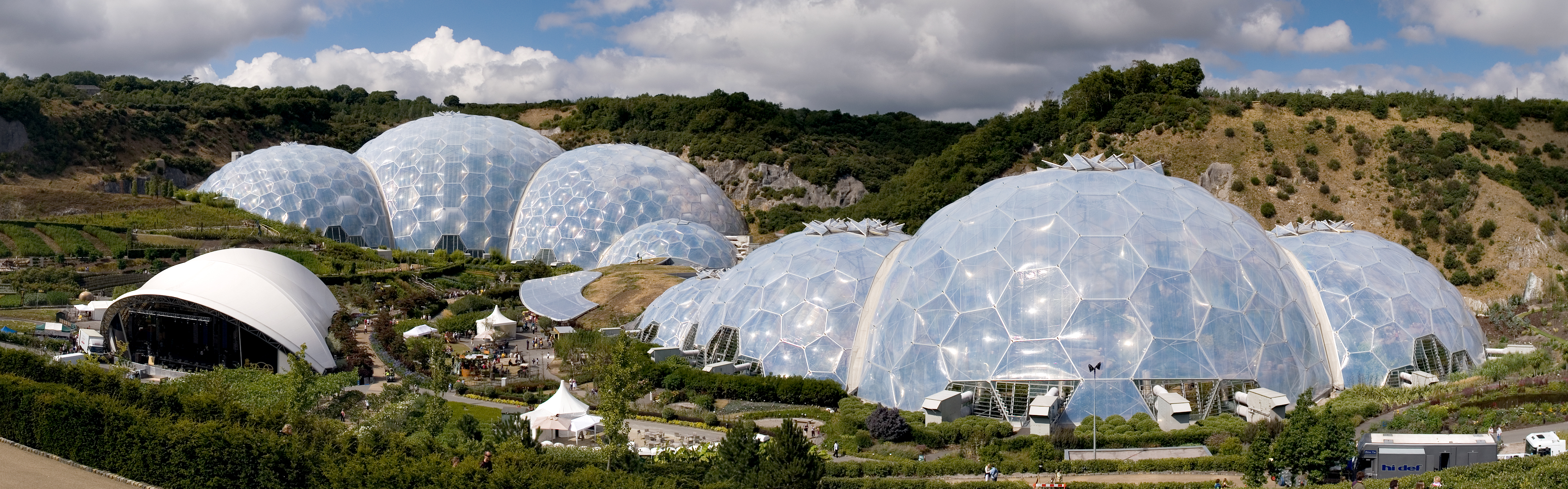
Buckminster Fuller and the Geodesic dome.


File:Eden Project geodesic domes panorama.jpg
available at: Jurgen Maten/12 August 2006/Geodesic dome
/http://en.wikipedia.org/wiki/Buckminster_Fuller/15/12/2013


Buckminster Fuller an American born in July 12, 1895 was a systems theorist, architect, engineer, author, designer, inventor and futurist.

A series of conflicts in his life led to many inventions on paper and development into 3D structures and the invention of the 4D design.
The first conflict was his being born into an aristocratic family and being one in a line of graduates from Harvard University, he failed to graduate from Harvard University.

The second major conflict came about after he was c by his leaving the navy in 1922 and co-founding Stochade Building Company, which produced lightweight building materials, the knowledge gained during these years proved invaluable to his later experiments with design and archeology.  In 1927 disaster struck to this company with consiquence that Fuller lost job, came bankrupt, living in public low-incoming housing in Chicago Illinois.

The third conflict was when his young daughter Alexandra died from complications from Polio and Spinal meningitis.  This felt him feeling responsible for her death, and led him to heavy drinking and contemplating suicide.

He recovered from these psycological conflicts by taking a decision to devote his life to others, embarking on experiments to discover and challenge himself.  He was a peniless unknown individual who wanted to see what he could be able to do effectively for humanity, mostly in the field of construction.

The first work as a result of these was inventing of a 4D design by building 4D tower - lightweight, prefabricated, multistorey apartments to be delivered anywhere by airship.  It could generate it's own light, heat and independent sewage disposal system - self sustainable concept (Futuristic at that time) this 4D concept was thought in future concept and not a 3D design where it only thought about immediate personal gain.  This reality is being experienced nowadays, where construction concepts cannot be just about design, but have to consider the needs of others and the environment.

available at: http://en.wikipedia.org/wiki/Buckminster_Fuller[Accessed 2 January 2013]

Thursday, 13 December 2012

Caravaggio - The ciaroschuro artist

Caravaggio, in his work, had a continual conflict between what was termed 'vulgar realism'and the expectations of the person or body who comissioned the work.

An example of this is the painting of St Matthew.

Caravaggio's first painting of St Matthew was rejected.  In this first painting he presented the saint as a bald peasant, with dirty legs and attended by a lightly clad, over familiar boy angel.
The church did not accept this and he redid-it.

The first painting was realism as Caravaggio knew it, since it was not the first time he found himself in a situation of poverty.

Caravaggio realism for which he became renounced showed up as early as his apprenticeship with Giuseppe Cesare, where his paintings showed physical particularity.

Caravaggio never resolved this conflict, since his art, more often than not reflected his life, and so his paintings show violent struggles, grotesque decapitations, torture and death, and only when the original paintings were rejected did he consent to repaint in a more idealistic style, "the stylised formality and grandeur"of Roman Mannerism.


available at: http://www.caravaggio-foundation.org/[Accessed 22nd December 2012]

Monday, 19 November 2012

Caravaggio and his painting of St John Baptist execution

The painting in question is the beheading of St John the baptist by Caravaggio.
Here we see two things in conflict(as always have and will remain) evil represented by darkness and the good represented by light.  

In this ciaroscuro painting, at the back on the right hand side, we see two prisoners jailed, looking through the window bar with heads within a slightly fading spot of light and their background in complete darkness this could easily represent the position a human being find himself after an act of evil, putting oneself into isolation or finding one self into isolation as distant oneself from goodness.  Caravaggio could easily be identified by this mentioned isolation as after a quarrel and seriously injery reaching the death of a police officer, he fled Milan in direction to Rome to find protection from authorities in mid 1952.  A phrase from his biography says he arrived to Rome 'naked and extremely needy...without fixed address and without provision...short of money'.
His friend Longhi introduced him to the world of Roman street brawls, and most of the time he got into serious trouble which lead him to move from a place to another in Italy.

His attitude started  to becoming bizarre sometimes sleeping fully armed and with his clothes, ripping up a painting at a slight word of criticism, mocking local painters and fleaing from a state to another when he got in serious trouble.

The two figures in the painting the executor and his victim in this case St John are lighten up from a dark background putting them in focus of the composition.
The executor can easily be identified with the force of evil and St John representing rightousness, but the light. 
available at: http://www.caravaggio-foundation.org/[Accessed 22nd December 2012]


File:Michelangelo-Caravaggio 021 Beheading-of-St-John-the-Baptist cropped.jpg

available at: http://upload.wikimedia.org/wikipedia/commons/d/df/Michelangelo-Caravaggio_021_Beheading-of-St-John-the-Baptist_cropped.jpg[Accessed 22nd December 2012]

Film - The Karate Kid Part 1


In this trilogy film the first from a series of three we see a young boy named Daniel Larusso of around 16 years being fatherless living only with his mum in New Jersey.  His mother, finding finding a new job with a computer company, had to leave with Daniel to a new state, that of Los Angeles.


The Karate Kid (1984) Poster

Daniel leaving his own friends behind, an inner conflict developes in him, that of adapting to a new way of life and having to make new friends against wanting to remain  safe as part of his previous life.

This development of inner conflict is shown throughout the film by portraying Daniel always alone with no one of his age around.  Only once we see Daniel meeting a new neighbour of his age who invited him to a beach BBQ.  This invitation develops into an outer conflict as well, as Daniel tries to get himself noticed by a group of girls of his age who were present.  One in particular named Ali. whose he got her attention and by the evening had gotten into a conversation by the beach.  It happened that Ali was an ex-girlfriend of a leader of a gang of karate students, known as the Cobras.

By night these guys came to the beach with motorbikes.   The leader came for Ali and he started shouting at her.   At this point the producer used a heavy rock music signifiying a sense of war.
Daniel intervened and this caused a fight between Daniel and the leader, ending in Daniel being kicked in his stomach and falling down with pain.  He felt miserable and wanted to stay alone, again the inner conflict between making or not making new friends.

Time went by, Daniel kept contact with Ali at school and in her presence he felt important and in touch to himself.  In her he saw the essence presence of fulfilled friendship, and things showed a sign of change, making us more aware of the innner conflict in himself.

By time throughout the film the bullying episodes kept repeating themselves.  Daniel sought a revnge on them, he wanted Miyagi, a Japanese old person working as a handymanin, at the court of apartments, to teach him karate but Miyagi understood that he wanted revenge.  Many times he told him that karate is a last resort to a problem.  Only when Daniel was badly beaten on a particular night and did Miyagi intervene, kicking them back and taking Daniel to care for him in his flat.

Miyagi, who believed Karate should not be used for revenge, however, felt he needed to help Daniel, another inner conflict.  That was the point when Miyagi accepted to help Daniel.
This started at first by Miyagi giving Daniel some home duties like waxing the car, phrase "wax on wax off",  painting a fence up and down strokes.  Daniel felt angry and his inner conflict was transformed lastly in Daniel by his agressive in his tone to Miyagi and wanting to leave.
Seeing this Miyagi shouted and asked Daniel to come in front of him. Miyagi made some punching moves and asked Daniel make the moves of "wax on wax off", and by this movement showed Daniel that these duties were a form of learning karate moves but at the same time developing a sense of internal control through discipline, the key to growth and control of the internal self, leaving one able to deal better with inner conflict.

Lastly his outer conflict is settled by taking part in a karate competition, which although the gang cheated on the rules in order to hurt and humilate him.  Through Miyage's advice about certain moves.
Daniel not only settled the outer conflict with the gang, by winning the tournament, but also his inner conflict by winning the friendship of his bullies and being accepted in society, shown through the applause, showing he became quite known and not just that lonly guy who no one knew.


Double Identity - Peter Parker versus Spider-man


One conflict which creators Stan Lee(writer-editor) and Steve Ditko(writer artist) conceived into this true character of Peter Parker and which made him a comic superhero, is the double role he had to play in his life, the first and true identity of an ordinary normal but very shy school college teenager and the second the American superhero he became on wearing his masked costume of the Spidy better known as Spider-Man.

Steve Ditko - writer-artist
The conflict in Peter Parker which many times shows and is never to be resolved is that while he got through the stages of his life from an orphaned baby, as his parents were killed in a plane crash as they were US government spies, to a child raised by his Aunt May and Uncle Ben, to a teenage high school student self obsessed with rejection, inadequacy and loneliness.  He was nerdy scientific student being frequently bullied by students of his age at Midtown High school.  It was at this time of feeling rejected and bullied by mates, at age 15, that an experience happened to change his life forever.  While attending a public science exibition, he was bitten on his hand by a spider that had been radioactively hit by a beam source, and this caused changes to his human body.

Stan Lee - writer-editor
In contrast to his weak human body, he was empowered with an arachnid's ability of super strength, agility, ability to cling to most surfaces, shoot spider-webs from web-shooters and also gained, of a sixth sense which made him aware of any incoming danger.

This experience made him with emotionally strength, as over time it was conceived as a change of role into social life from a rejected, unaccepted and inadequate guy to a superhero to both teens and people of New York.


Spider-Man.jpg


available at: http://en.wikipedia.org/wiki/Spider-Man[Accessed 2nd November 2012]

Sunday, 18 November 2012

DC Comics super hero - The Batman

The creation of the American comic superhero Batman was created by comic book artist and writer Bob Kane and comic strip and book writer Bill Finger.


available at: http://omegaie.com/gamepro-cover-batman-by-vegasmike-on-deviantart.html

All the stories of Batman deal with the conflict of good against evil.4
The superhero identity is Bruce Wayne, an American millionare playboy, industrialist and philanthropist living in a huge mansion named Waynor Manor, inheritance by Wayne's family from several generations, surrounded by vast country lands outside Gotham City.  This mansion was looked after by Wayne's servant Alfred Pennyworth.

There is an ongoing secondary conflict, because although Bruce wanted revenge against criminals for the killing of his parents he does not take it, but brings criminals to justice.

Most of, if not all, the stories of Batman's conflicts take place in a fictional city called Gotham City.
Witnessing the murder of his parents as a child and knowing that Gotham City was becoming corrupted, with high criminal offences which not even the police could control, he swore that one day, when grownup, he would take revenge on criminals and bring back Gotham City under law and order.

Bruce, at this point grownup as a man, created a Bat themed costume, consisting of a black hood with slits for eyes to look more mysterious, a cape looking like stiff bat wings which could transform him into a secret operational night detective to solve and fight criminal offences.

While wearing this bat costume, he trained himself physically and intellectually, acquiring detective skills.  Using hi-tech science and technology equipment he trained in martial art skills and become confident in managing his Will, Fear and intimidation and made his special abilities a form of superpower to fight any kind of conflict created by one of his criminal enemies who tries to control Gotham City.
Batman operated his strategies from the called Batcave, a cave system under the Wayne Manor house.   This cave was discovered by Bruce Wayne when he was a boy and access to it was from a hidden door in his house.

His criminal enemies were various, such as, to mention a few, the Joker who was his strongest enemy, the Riddler, Two-face, Scarecrow, Poison ivy and many more.

The artist, together with the comic strip writer, and other licensed creators, used the superhero Batman to create a conflict with one of his enemies in order that a comic book story is created, and with special artistic and writing skills gave each story a thrilling and exciting episode in Batman's life.

RiddlerGA.JPG
The Ridlder
Manwholaughs.jpg
The Joker 


available at: http://en.wikipedia.org/wiki/Batman[Accessed 30th October 2012]

Saturday, 17 November 2012

Alfa Romeo - The 4C Prototype model

This model, the 4C Alfa Romeo concept car, has an aggressive front, like most Alfa's.  The shape is like a bullet, which makes it better aerodynamical.

The design of cars always seems in conflict with it's surrounding environment because it has to fight air resistance and road friction to move but it's Lava Red Body emphasises such conflict anyway.
The process of such a creative concept started as most other sports car designs, from the designer's pencil sketches, done on the drawingboard.  These sketches show all emphases and enthusiasm on the dynamic body shape, showing the streamlined shape and each sketch improves on the one before.

Last final sketches integrate one's feelings and conviction for a successful design and for having a unique shape.  After all these sketches, the designer started a technical design.  These show the relevant precise details and measurements of this concept car in 2D.

Once the technical design is completed, the design is formed into a 3D concept by making it into a clay model.  This was done to a scale of 3/8 of the real final product.  The Alfa 4C, with its curves and smooth lines is taking shape.

An actual hard model looking like the final real concept car is made.  It is 4m long and has a wheel base of 2.4m.

The final real model is made of a carbon fibre chassis with a floor pan that includes space for seats.

Aluminium is used at the back and at crash boxes, to help make the car lighter.  This is like carbon fibre chassis and getting the best centre of gravity.

This bring again the conflict between the powerful agressive performance expected of the racing car with its light body and shape that hide "Maximum agility and road holding is achieved through sofisticated suspensions."

The strong and agressive performance is because of a turbo  concept car having strong volumes and cross sections at rears and at the front having to long muscles that give rise to two front wings and a ' V'shape on the bonnet ending in a distinctive badge.

Maximum agility and road holding is achieved through sofisticated suspensions.

The strong and agressive performance is because of a turbo petrol engine placed in the centre which can accelerate 0 to 100km in just under 5 seconds.

The designer's sketch becomes the powerful car, ready to take on the fight with the environment to be the fastest.

available at: http://www.alfaromeo.com/com/#/design/4c-concept [Accessed 10th November 2012]


Name of Film: The Last Samurai


This film, the Last Samurai, takes place in 1876 in Japan.

The main part of Nathan is played by Tom Cruise.  Nathan is an ex-cavalry officer engaged by the Emperor of Japan to train the Japanese Army.  During a battle with a samurai clan he was captured and taken prisoner.  He lived with them for 2 seasons.  Although he was a prisoner he discovered an inner peace by finding himself.
In a final battle, where many are killed, he vanishes through the mountains.

The inner conflict experienced by Nathan in this story is shown by __through flashbacks and guilty feelings about a Massacre of American Indians.  A bright blue colour in these scenes gives these flashbacks a unity and continuity to help the viewer.  At first Nathan tries to resolve this conflict by turning to alcohol, shown through the continued presence of a bottle of whisky.


When the inner conflict is resolved we do not see the bottle anymore.

During his time in command this inner conflict, was shown through the parts played by the other officers and his continued rebellion against authority and his agressive personality.

This inner conflict is also shown through a fast pace in filming and the use of dark colours.  When he is taken prisoner the pace of the film seems to change.

One scene as soon as he is taken prisoner shows a fight between him and his captor inthe rain and although he loses, this seems to be a turning point in the inner conflict.